
How enterprise teams combine human expertise, AI agents, reusable skills, and governance to turn business intent into production-grade products.
Agentic Engineering is not a faster way to write code. It is a better way to design, build, validate, and operate enterprise software with AI embedded across the lifecycle.
The next leap in enterprise software delivery will not come from simply giving developers AI coding assistants.
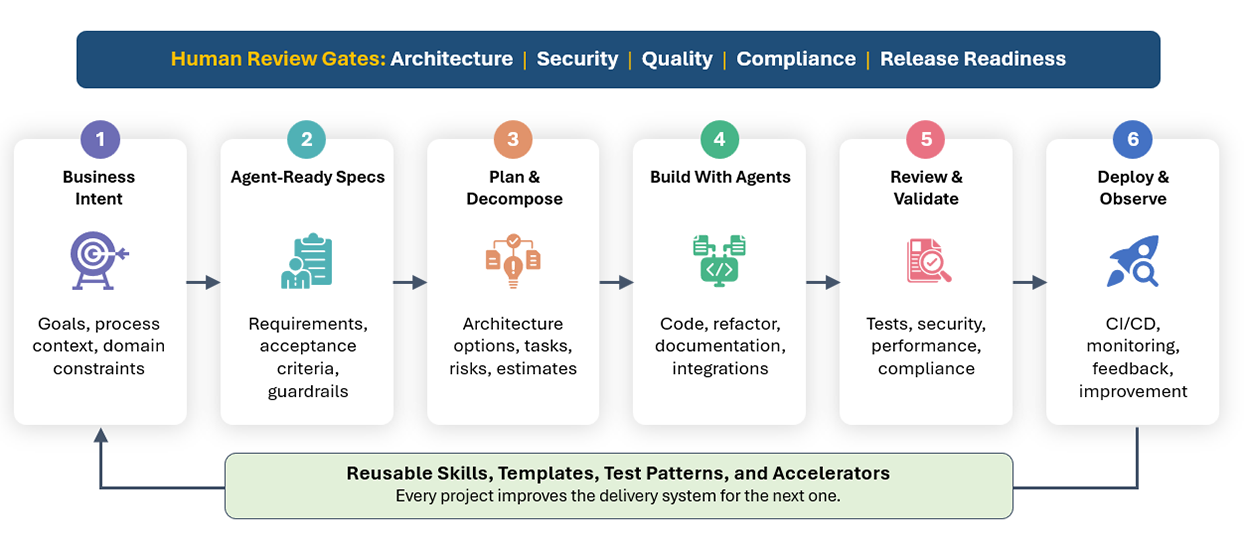
It will come from rethinking how products are specified, planned, built, reviewed, tested, secured, deployed, and continuously improved with AI agents embedded across the full engineering lifecycle.
This is the shift we call Agentic Engineering and these teams @Aress are called Agentic Engineering Teams.
Agentic Engineering is not just about faster coding. It is a new delivery model where human engineers, AI agents, reusable skills, domain knowledge, governance, and automation work together from idea to production.
In an AI-first approach, Agentic Engineering sits at the core of product development. Teams @Aress use modern frameworks and tools such as Codex, Claude, Windsurf, and custom agentic workflows to accelerate delivery across specifications, planning, execution, review, testing, deployment, and continuous improvement.
At @Aress, our specialized Agentic Engineering teams partner with enterprises to design, build, and deploy software initiatives with greater speed, quality, and operational efficiency.
The real question is no longer whether AI can help teams write code. The question is whether AI can help enterprises ship better products faster, with quality, governance, and domain relevance built in from day one.
The important lesson from real enterprise projects is simple: Agentic Engineering is not a tool adoption story. It is an operating model transformation.
Traditional engineering teams often split work across many specialized roles. Agentic Engineering changes that structure. A strong Agentic Engineer can now handle responsibilities that previously required separate AI engineers, QA automation engineers, DevOps engineers, MLOps engineers, and documentation support.
That does not mean specialists disappear. In enterprise environments, shared experts in architecture, security, compliance, infrastructure, and governance still play an important role. But the core delivery pod becomes much more capable, autonomous, and outcome driven.
Al agents participate across the full delivery lifecycle, while humans set intent, review trade-offs, and own production outcomes.
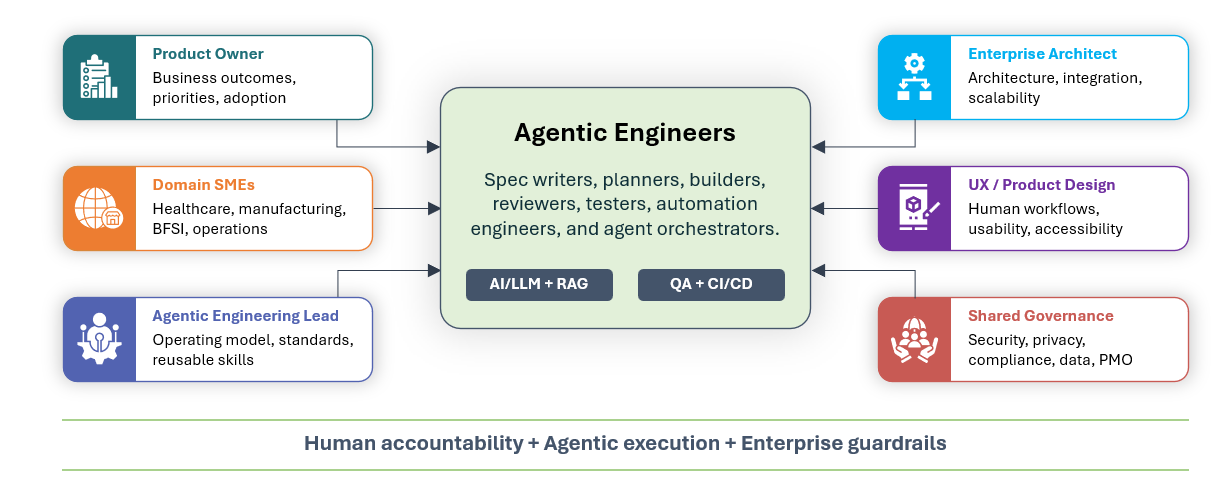
A typical enterprise Agentic Engineering team, @Aress, combines business ownership, domain knowledge, architecture, agentic execution, experience design, and shared governance. The structure below reflects how we see high-velocity AI-native project teams working in practice.
A compact delivery pod where Agentic Engineers own end-to-end execution, supported by domain, architecture, design, and governance roles.
| Role | Primary contribution |
|---|---|
| Product Owner or Business Process Owner | Owns business outcomes, product priorities, adoption success, and alignment with enterprise goals. |
| Domain SMEs | Bring industry and process expertise across areas such as healthcare, manufacturing, BFSI, compliance, operations, and customer workflows. |
| Agentic Engineering Lead | Defines the agentic delivery model, selects frameworks, establishes review gates, manages reusable skills, and ensures AI is used responsibly across the lifecycle. |
| Solution Architect or Enterprise Architect | Owns architecture decisions, integration patterns, scalability, reliability, data flows, cloud alignment, and enterprise technology fit. |
| Agentic Engineers | Own end-to-end delivery with AI agents: write specifications, break down work, guide agents, implement features, review generated code, build tests, automate workflows, create reusable skills, and ensure production quality. |
| UX/Product Designer | Ensures the product remains human-centered, usable, accessible, and aligned with real user workflows. |
| Shared Enterprise Roles | Security, privacy, legal, compliance, data governance, infrastructure, change management, and PMO roles support the delivery pod at the right checkpoints. |
The Agentic Engineer is not only a coder. They are a spec writer, planner, builder, reviewer, tester, automation engineer, and agent orchestrator. In many enterprise projects, they also take responsibility for:
Agents are excellent at generating first drafts, exploring alternatives, refactoring, writing tests, creating documentation, and accelerating repetitive engineering work. Agentic Engineers bring judgment, context, architecture, review discipline, and production accountability.
The combination is what creates enterprise value: speed without losing control, scale without losing quality, and automation without losing accountability.
Every project should make the next project faster. That is why leading AI-first teams invest in custom skills, delivery playbooks, architecture blueprints, test patterns, reusable prompts, domain templates, and solution accelerators.
Enterprise value comes from layering agents on top of context, reusable assets, automation, validation, and governance.
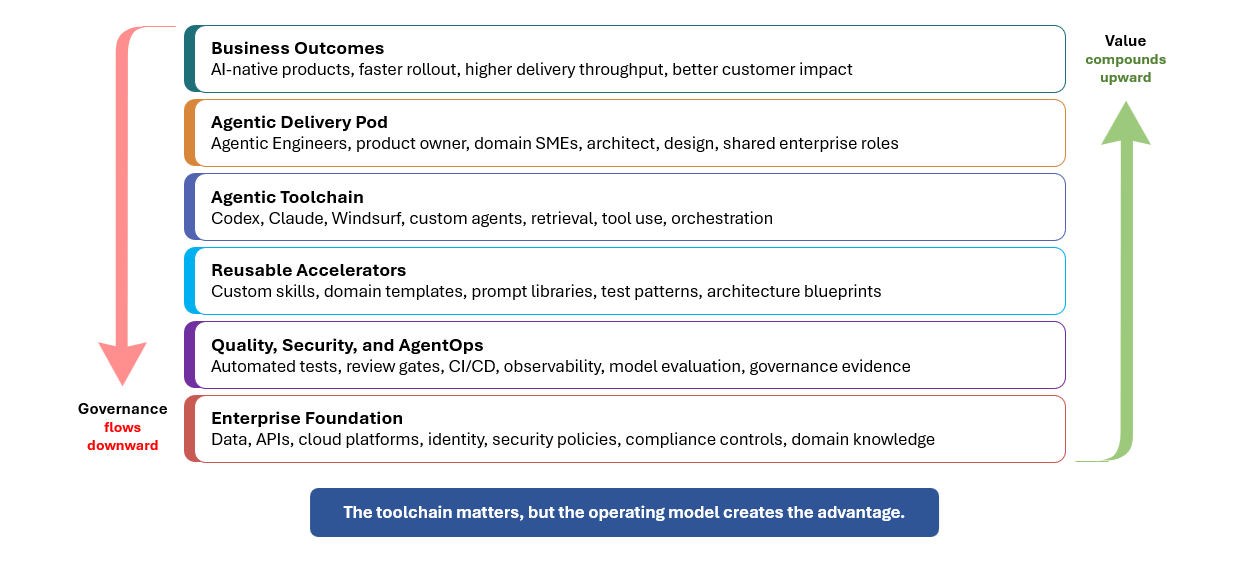
In our enterprise implementations, we have adopted structured Agentic Engineering methodologies such as BMAD (Breakdown, Multi-Agent, Autonomous Delivery) to decompose complex business requirements into orchestrated AI-driven delivery workflows with built-in governance and validation.
We also leverage reusable enterprise AI “superpowers” and skills for architecture generation, secure coding, automated testing, documentation, and deployment acceleration to improve consistency and speed across projects.
The companies that win with Agentic Engineering will not be the ones with the most AI tools. They will be the ones that redesign delivery itself.
They will combine domain expertise, enterprise architecture, secure engineering, agent orchestration, reusable skills, automated validation, and disciplined governance into one integrated way of building.
Agentic Engineering is not just a faster way to develop software. It is a better way to turn business intent into enterprise-grade products.
For organizations serious about becoming AI-native, Agentic Engineering will become one of the most important capabilities of the decade.
At @Aress, our specialized Agentic Engineering teams’ partner with enterprises to design, build, and deploy software initiatives with greater speed, quality, and operational efficiency.

 +91 253 6630710
 781.258.1274
 +44 (0) 7446 87 37 97